Thanks to everyone who joined SEUSKF/AUSKF this year. Here is the final list of 22 members (our largest ever): ____________ Kazuto Yasuda Rogers Gossett Don Crittendon Wayne Edge Walter White Billy Delancey Larry Runnels Adam Wilson Nick Runnels Corbin Runnels William Thornton-Leonard Conrad Delancey Rowan Troyer Darren Williams Thomas Davis Joshua Schoeneberger Seth Patterson Christopher Cole Salman Ali Abidi Jeremiah Mazurek Jonathan Kahre
February 16, 2007
November 22, 2006
A couple pics from 2006 SEUSKF tournament
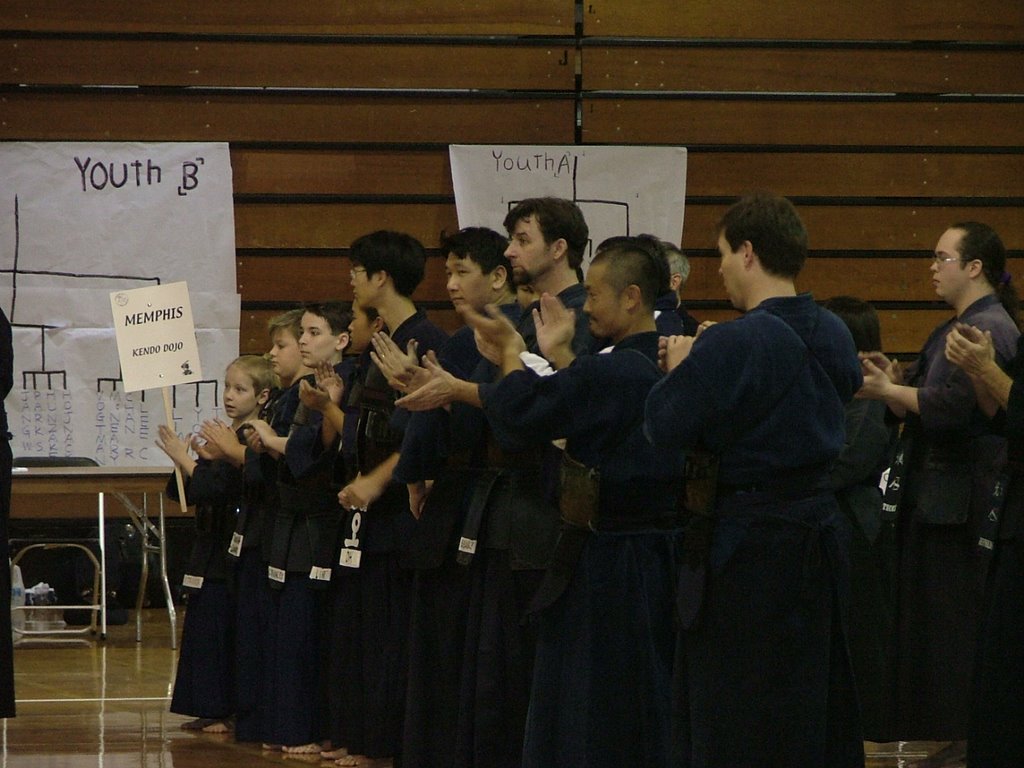
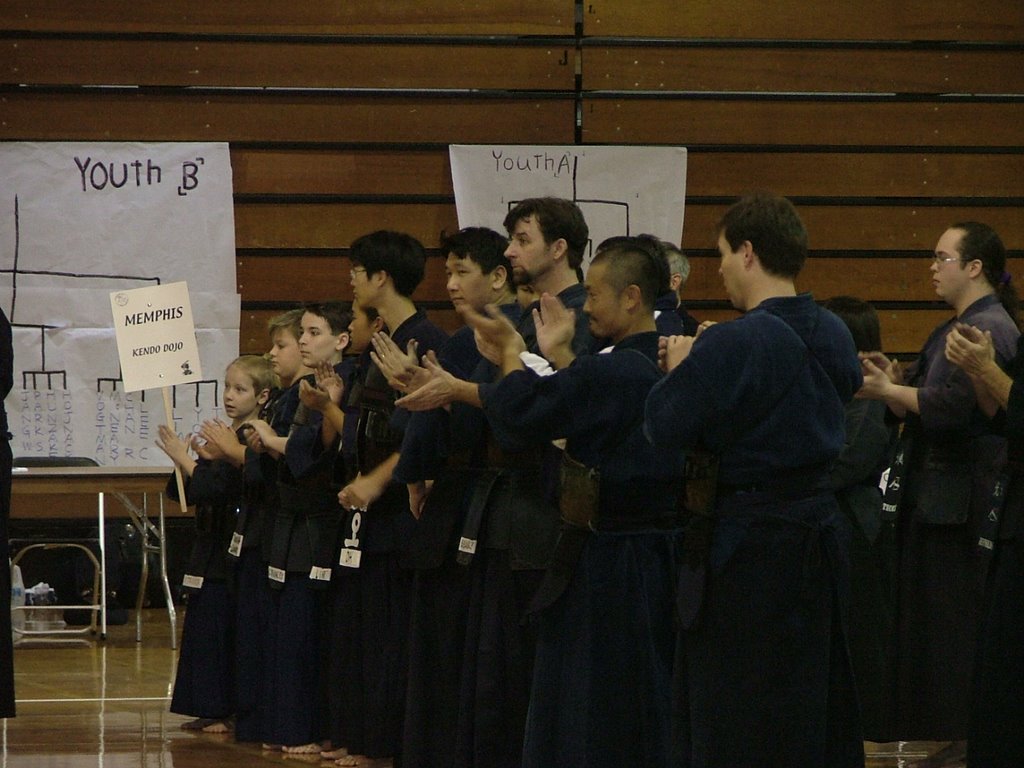 Memphis Dojo:
L to R: Rowan Troyer, William Thornton-Leonard, Conrad Delancey, Ester Lim, Steven Oh, An Giang, Billy Delancey, Kazuto Yasuda, Don Crittenden
(not visible: Larry Runnels, Corbin Runnels, Nick Runnels, Adam Wilson, Walter White, Rogers Gossett
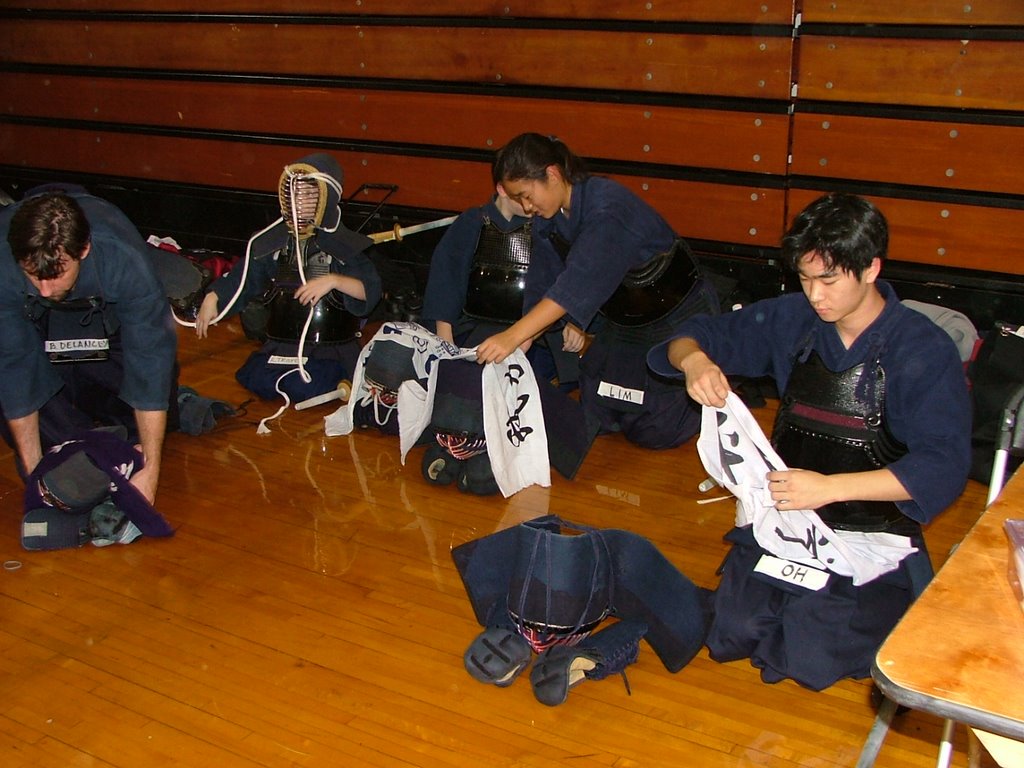 Memphis B Team
L to R: Billy Delancey, Rowan Troyer, Conrad Delancey (slightly hidden), Ester Lim, Steven Oh
November 21, 2006
Memphis results at 2006 SEUSKF Tournament/Testing
There were approximately 130+ competitors at the 2006 SEUSKF Tournament, hosted by Triangle Kendo Club in Chapel Hill, NC this past weekend. It may have been one of the biggest SEUSKF tournaments in recent memory. Every year, it seems to get bigger and bigger as more people take up kendo throughout the southeast. For most of the Memphis contingency, it was their first tournament. I think it was an overall good experience for everyone. For some, it was their first time doing kendo with someone outside of our own dojo. For others, it was only the second time. In the individual divisions, we unfortunately did not have anyone place. Since Yasuda-san and I were tied up as shinpan in other rings, some of the details of individual performances are lacking (for now). The youth divisions, as well as the 1.dan-2.dan division, had more participants than I can remember in years past. Some of the details I can recall for the time being: William Thornton-Leonard actually won two of his matches in the 1st round/round robin but for some odd reason was not advanced to the 2nd round. (Still not sure why that happened). Yasuda-san, competing in the 3.dan+ division, had arguably the toughest draw of any competitor in the entire tournament. For the first round/round robin, he drew 5.dan Hyun-sensei (TMG) and 4.dan Yoshida-sensei (TKI). Yoshida-sensei wound up advancing to the quarter-finals before losing to Tanaka-sensei (4.dan?, GKA), who went on to finish in 2nd place in the division. For myself, I drew Kim-san (3.dan, GKA) and Imai-sensei (5.dan, TMG), the latter of which placed 1st in the division. I'm looking forward to this Wednesday's class to try and piece together how everyone did in the individual competition. The level/quality of competition was quite fierce this year and the future of SEUSKF kendo looks good with younger and stronger players emerging and developing. In the team competition, the Memphis A team tied for 3rd place (out of 19 teams). This was the first time in the club's history that a team has placed in the SEUSKF tournament. Memphis A consisted of: Senpo - An Giang (3.dan) Jiho - Walter White (1.dan) Chuken - Don Crittenden (2.dan) Fukusho - Rogers Gossett (3.dan) Taisho - Kazuto Yasuda (3.dan) En route to the 3rd place finish, the Memphis team lost to a very strong team from Georgia Kendo Alliance (GKA) which eventually went on to win the team division. The Memphis B team had a tough road to climb from the onset. This was the first tournament for every member of the team. Unfortunately, since the A team was competing at the same time, I don't recall who the B team faced. I do remember some details, and some were provided after the fact. Senpo Rowan Troyer (unranked, 9 yrs old, all of 4 ft tall) fought his match to a stalemate, which in team competition can be as good as a win. Jiho Conrad Delancey (4.kyu, 12 yrs old, all of 4.5 ft tall) lost his match by only one point to a player more than twice his height and almost twice his age. I know that _____-sensei is very very happy with the results of both teams and is sorry that he missed out on the trip!! Final tournament results for each division will be posted as soon as possible. Without question, the strongest contingency for this year's tournament came from GKA. Arai-sensei (6.dan) informed me that they have up to 80 regular students now, with some very strong 3.dan and 4.dan players. There is also a 1.dan player from GKA who is showing some strong development in using jodan. I can't recall his name, but we will all be seeing him again in the future --- he'll be someone to watch out for! TESTING RESULTS: =============== Congratulations to everyone who passed his test: Rowan Troyer - 6.kyu William Thornton-Leonard - 4.kyu Conrad Delancey - 3.kyu Billy Delancey - 1.kyu Adam Wilson - 1.kyu Ester Lim - 3. kyu Larry Runnels - 1.kyu Nick Runnels - 5.kyu Corbin Runnels - 5.kyu Walter White - 2.dan (Sorry if I have forgotten anyone's name here).. REMEMBER: There WILL be class THIS Wednesday (the day before T'giving). Class will be pretty light, with some discussion on everyone's tournament experience.
October 20, 2006
Memphis Kendoists get noticed at Iaido Nationals..
Link to the full story from the Cinncinnati Enquirer http://news.enquirer.com/apps/pbcs.dll/article?AID=/20061002/NEWS01/310020015/1056/NEWS01 Quoted in part: During the last few days, Cincinnati became the center of attention for Iaido lovers, teachers and students across the country as it hosted the U.S. Samurai Sword Championships and Seminar for the first time at the Corryville Recreation Center. [...] The youngest competitor was 12-year-old Conrad DeLancey, 12, of Memphis. He and his father took up the sport about a year and a half ago and came to their first competition this weekend along with their teacher, known as a sensei. He’s one of the younger Iaido students, Atkins said. The art takes such discipline and practice that it helps kids stay focused. It also teaches manners, posture and respect. The care used when they fold up their robes after competition rivals that of an American flag being folded.“I just always wanted to learn how to use a sword,” said the dark haired, freckled boy. “I think that’s just neat that you can know how to use it and use it without cutting yourself.” +++++++
March 21, 2006
2006 SEUSKF Stats
There are 24 dojos that make up the SEUSKF. 318 kendoka have registered with the regional and national federations. - 76 youths (17 and under) - 242 adults (18+) - 259 males - 59 females Memphis is the 6th largest dojo in the SEUSKF with 18 registered memebers. The top 10 are: 1. Gulf Coast Kendo Club (Bradenton, FL) - 52 members 2. Georgia Kendo Alliance (GKA) (Atlanta, GA) - 42 members 3. Koryo Kendo Club (Richmond, VA) - 36 members 4. Annapolis Kendo and Iaido Club (Annapolis, MD) - 23 members 5. Triangle Kendo Club (Raleigh-Durham, NC) - 21 memebers 6. Memphis Kendo (Memphis, TN) - 18 members 7. (tie) Tennessee Meiji Gaikuin (TMG) (Sweetwater, TN) - 16 members 7. (tie) Northern Virginia Budokai (Fairfax, VA) - 16 members 8. Northern Raleigh Kendo Club (Raleigh, NC) - 15 members 9. Charlotte Kendo Club (Charlotte, NC) - 14 members The SEUSKF covers 7 states: Florida Georgia South Carolina North Carolina Virgina Maryland Tennessee
February 24, 2006
IMPORTANT: New SEUSKF News (2/24/06)
I received an email from Sensei Jim Parker, President of the SEUSKF, regarding some important stuff that concerns all of us ... members and non-members alike. I'll cut right to the chase and paraphrase the email (most of it is direct quoting): 1. If you are not a member of the SEUSKF or the AUSKF, you will either pay a higher fee for participating in SEUSKF activities or you will not be allowed to participate in SEUSKF activities. It is not fair for paying members to subsidize a non-member. 2. Members of another region may be required to pay a higher fee for participating in SEUSKF activities. 3. A non-member of the SEUSKF/AUSKF will not be allowed to test. [MKC's note: #3 is not exclusive to SEUSKF regional events where promotionals are held. It *DOES* include in-house promotions!!!] 4. Dead Lines for registration will start to be enforced. If you show up to a tournament or an exam on that day - you will most likely not be allowed to participate. [MK's note: Make special note of this if you have NOT signed up to join the SEUSKF/AUSKF for THIS year, you will NOT be allowed to compete at the SEUSKF annual tournament in the Fall of 2006 if you intend to sign up "on site"...] 5. Applications may begin to require you to show proof of membership. Kendo Card: If Nationals doesn't prepare-the SEUSKF will. 6. Promotion exams: a. If you are not in bogu-there is no reason to be testing. b. The sensei of the Dojo/Club should be involved in recommending what rank someone is Challenging. Simply putting down "judges decision" doesn't help us judge where to place this individual and could harm a better player's change of passing by being paired up with a lower skilled opponent. c. The dojo/club sensei's signature and recommendation is a part of the application. 7. People who are not participating need to get involved to help run the tournaments, promotional exams, etc. This is part of kendo training and needs to be taught in the dojo. Every kenshi at about 3-kyu and above should be able to help score at the table, keep time, run flags & locate competitors. Sho-dans and 2-dans should be being taught how to shimpan in the dojo so that when they become 3-dan and have to judge in the SEUSKF tournaments - they will have some knowledge. 8. To test outside the SEUSKF, you must have the SEUSKF presidents signature and permission to test as well as your dojo/club sensei. ++++++++++++++++++++++++++++++++++ 2006 SEUSKF Tournament ++++++++++++++++++++++++++++++++++ The SEUSKF is looking for a Dojo/Club to help put on this years Tournament. At a minimum we will need space for 3 courts and possibly 4. This primarily involves arranging for a gym, tables and chairs for the court, tape for the floor, stop watches, medals/plaques (this could be done by the SEUSKF or by the dojo/club), possible banquette, brackets (can be done by SEUSKF and/or the Club). This tournament is normally held in October or early November. MKC Note: Memphis last hosted the SEUSKF Annual tournamnet sometime around 1997 with pretty decent success thanks to the efforts of Dach-sensei who did pretty much all the work himself. Hosting a tournament is a MAJOR undertaking, but with the number of people we now have involved in our group, it would not be an impossibility. This is something the group should perhaps consider doing -- if not this year, then maybe next year. It's not entirely fair that the same groups wind up hosting it year after year (namely, Charlotte and the Citadel groups) because of everything involved, but it's also not entirely fair that the tournament always seems to be held so far away from Memphis, thus limiting who from our group can go and get some much needed experience practicing with other kendoka. The items listed above from Parker-sensei's email barely scratch the surface of what's needed. The primary factors which need to be taken into consideration are: 1. Securing an area for the tournament (in our case, possibly the community center's gym), 2. Arranging the post-tournament banquet, 3. Securing/arranging hotel availability for travellers, 4. Securing/arranging ground transportation for any groups who fly into Memphis, 5. Sharing some of the costs for VIPs (read: normally visiting sensei from other federations who may be invited)... hotel rooms, food, transportation... As I said, it's not impossible for a group our size to host this tournament, but if we offer to do it (it would be immediately approved, trust me), ALL of us must be committed to helping out in every way possible. It MUST be a group effort!!] The SEUSKF is also asking dojos to host kendo AND/OR iaido seminars. [If we are not willing or are unable to do the SEUSKF tournament, a kendo/iaido seminar would be another great opportunity for our group. In order to pull off a seminar, the same basic 5 things listed previously would still be needed (perhaps minus a banquet) but on a smaller scale. Memphis last hosted a NATIONAL iaido seminar a few years ago which was met with much success.] MORE NOTES: If Memphis were to host the SEUSKF tournament or a kendo/iaido seminar, there is a GOOD chance that we would get players from other federations to participate, due to Memphis' central location and airport accessibility MORE SEUSKF NEWS: We are trying to get a SEUSKF web site up to help post more information. Again your input and assistance is always appreciated. The most important thing is to spread the information that is put out to other members. +++++++++++++++++++++++++++++++++
February 02, 2006
SEUSKF News Items
2005 SEUSKF Tournament Results:
Shodan-Nidan Division:
1. Chang Oh (GKA)
2. Yuki DeSouza (GKA)
3. Nobuhiro Sekita (TMG)
3. DON CRITTENDON (Memphis)
Sandan+ Division:
1. Kotaro Yoshida (Triangle)
2. Yukihisa Tokunaga (Triangle)
3. Yoshimi DeSouza (GKA)
3. Daisuke Sugiyama (Dartmouth)
Seniors (45 and up):
1. Shinobu Maeda (TMG)
2. Don Seto (Shidogaikuin, DC)
3. Kunitoshi Arai (GKA)
3. Sokichi Kishi (Orlando)
Junior Youth (12 and under)
1. Ryo Eguchi (Torrance)
2. Brandon Oh (Koryo)
3. John Murden, Jr. (CKIC)
Senior Youth (13-17 yrs old):
1. Yuki DeSouza (GKA)
2. Akira Hara (GKA)
3. Uendae Park (GKA)
3. Nobuhiro Sekita (TMG)
Women
1. Yoshimi DeSouza (GKA)
2. Yatsuki Hoang (Koryo)
3. Jessica O'Quinn (GKA)
3. Ryoko Barr (GKA)
Mudansha
1. Yoo Chong (GKA)
2. Tae Youn Park (GKA)
3. Shunsuke Kishi (Orlando)
3. Pavel Litterback (GKA)
NO TEAM DIVISION WAS HELD
=========================================
Ken Strawn's Travelling Tip:
When you fly to a Kendo event, you may have encountered the problem [Ken has]. Besides [his] bogu bag and shinai bag, [he] must carry an additional case for [his] kendo prosthetic. When you fly coach, you are restricted to two bags. Twice [he has] had to pay an additional $80 for the third bag.
[Ken] recently flew to California for a kodansha test and this happened again. The lady processing [his] luggage told [him] to tape two of them together and the airline would count it as one. On the return trip, [he] tried this with duct tape --- and it worked!
Remember though, in this post-9/11 world, to put the tape on in a manner so that the suitcase can be opened for inspection without the agents having to cut away your tape and lose one of your bags.
===================================
A couple notes from the SEUSKF Board of Director's Meeting --- 17 Sep 2005
1. Treasurer's report -- ending balance as of 9/14/05 was $7,961.05
Total SEUSKF membership: 274
2. Promotional issues: Ken Strawn brought up his feelings that dojo promotionals are getting out of hand. No procedure for holding the promotional has ever been sent to the dojos. Main issue is that permission must be asked of the Vice President of Promotions (Mike Quinn) or results will be nullified. Dojo promotionals can go no higher than 1-kyu. New procedure will be issued.
3. Citadel Seminar -- March 9/10 with Kakehashi Sensei (8-dan) and Miyazaki Sensei (7-dan). SEUSKF agress to pay for one sensei's ticket. A seminar fee will be charged to help cover the other sensei's ticket. Suggested to hold spring promotional in conjunction with this seminar in order to promote attendance (spring promotional usually held at TMG). Plan is for only SEUSKF members allowed to attend.
4. Mentoring -- Maeda-sensei requests travel expenses be paid by SEUSKF for his traveling once a month to assist new dojo in Nashville. After reviewing SEUSKF policies and procedures, dojo must request mentor ahead of time and nothing has ever been set about paying mileage for mentors. As SEUSKF cannot afford to send mentors to every dojo who requests one, it should be the responsibility of the dojo to pay travel expenses for a mentor as much as possible. It is decided to pay Maeda-sensei who traveled in good faith for the two trips he already had made and to decide future requests on an individual basis.
5. Arai-sensei has been asked to become Vice President of Competitions
6. Next meeting is set for January 28, 2006 in Charlotte.
+++++++++++++++++
SEUSKF Board of Directors:
President - James Parker (jamesparker@coastalnow.net)
VP-Promotions -- Mike Quinn (mquinn6@hotmail.com)
VP-Education -- Shinobu Maeda (shinobu7358@bellsouth.net)
Secretary -- Eddie Miller (eddiemiller@OrlandoKendo.com)
Treasurer -- Ken Strawn (kenstrawn@earthlink.net)
At Large -- Kentaro Hara (kentaroh@bellsouth.net)
At Large -- John Murden (john.murden@citadel.edu)
At Large -- Kotaro Yoshida (Ky7@duke.edu)
December 06, 2005
Honda-sensei on Ji-geiko (Part 2)
This is VERY good information for everyone! (pay close attention to the highlighted sections of the article...)
I doubt Honda-sensei of the British Kendo Association will ever see this little blog of ours, but if he does, I hope he understands how great his thoughts are on this.
Original link: http://www.kendo.org.uk/articles/jigeiko/02/
__________________________________
1. Ji-geiko with Seniors
What should be mentioned, firstly, is to try to get Sho-dachi (the first cut) no matter who you are having the Ji-geiko with. Irrespective of the difference in grade and experience.
Ji-geiko should start with Ippon Shobu played in earnest in an equal fifty-fifty situation, with the philosophy: that there is no second chance in a fight with real swords. It is important to understand this philosophy in Kendo as Budo and try to get a successful Sho-dachi by utilising all of your abilities to the full.
After attacking and defending Sho-dachi, in this Ji-geiko with someone senior, you are recommended then to focus mainly on Shikake-waza. However this does not mean merely attacking randomly against seniors. If you are of a low grade such as Ikkyu and Sho-dan, it is important to attempt to break the senior’s Chu-shin [centre] by making the best use of your footwork, Shinai and body movement. It is also important not to be afraid of being avoided and counter attacked, and not to stop attacking in the middle of your action, but to always try to complete your attack. You are supposed to develop various ways of Shikake-waza such as: by being avoided or being struck Debana-waza and Ouzi-waza, repeatedly . However it is not profitable for you to be struck as a result of waiting for the senior to attack. Try to use all the Waza you have and give 100 percent effort. Sumi (2000) points out that juniors should focus only on Shikake-waza and try to do Ji-geiko that makes them use up all of their energy in 5 minutes when they have Ji-geiko with a senior.
2. Ji-geiko with Juniors
There is no need to stress the importance of Sho-dachi here any more. What you should consider when doing Ji-geiko with a junior, is not to lapse into a Ji-geiko where the only intention is to obtain satisfaction by merely beating them. People tend to feel that they want to impress other people who are watching their Ji-geiko. Such vanity should be severely admonished. From the viewpoint of showing responsibility as a senior, you have a responsibility to develop the juniors’ skills by making them realise their weak points, by striking them in that weak moment, but also by letting their strong points come through and striking you during the Ji-geiko. This type of Keiko is called Hikitate-geiko (All Japan Kendo Federation, 2000) and is one of the most difficult Keiko to do in Kendo. Juniors will lose their enthusiasm and concentration if seniors just keep on striking them for their own satisfaction or if the opportunity to strike is too obvious. To enable the junior to improve, a senior is expected to perform as though their skill level was 0.5 dan higher than the junior and to concentrate 100 percent when facing them. The senior should counterattack when the junior makes an attack without first making an effective Seme and when there was no appropriate opportunity, but let them strike when they come to attack after making a good Seme and when there is a good opportunity. The senior should encourage the junior to grasp and understand the correct opportunity to strike though this Hikitate-geiko.
Seniors are also expected to encourage juniors to understand the importance of maintaining concentration by attacking if the junior is careless after their attack.
There is a saying that explains how a senior should approach Ji-geiko with a junior: “Ware igai mina shi nari (everyone is one’s teacher)”. That is, there is always something to learn through Ji-geiko no matter who one does it with. One quite often hears, “I am the highest grade in my Dojo and I have no one to teach me.” This is not true. It depends on the way you think. Keep in mind that you can learn a great deal from whoever you do Ji-geiko with.
It is often taken for granted that seniors can strike juniors easily in Ji-geiko , so for your further improvement, you should not just focus on striking but tackle Ji-geiko with a clear task(s) or by giving yourself a handicap in this Ji-geiko with juniors. However, you must not stick to a form of Ji-geiko whereby you only focus on cutting Men for instance, as even if you try to focus on cutting Men, you need to have a clear idea such as: from what distance to cut Men and on how to make an opportunity. As to giving yourself a handicap, it is also important to explore how to perform under adverse conditions. For example, dare to fence in Chika-ma during Ji-geiko with someone smaller than yourself and to watch for a chance of doing Debana-waza (instead of waiting you should try to lure your opponent into attacking the target you want them to strike!).
I would like to repeat the point that seniors must not lapse into Ji-geiko where the aim is to obtain satisfaction, just by striking more times than their opponent has.
3. Ji-geiko with Someone of the Same Level
Ji-geiko with someone of the same level gives you a good opportunity to reflect upon your progress and the fruits of your efforts. This is even better if you are both about the same age. It is very important for you to know someone of the same level and of a similar age and to do Ji-geiko with them. It’s quite normal not to want to be struck by your rival, but it is quite important to have an attitude whereby you try to show your best Kendo no matter what happens. After they are struck, people also tend to try to return the attack before making enough Seme. It is important to control this feeling and try to start again with the taking and re-taking of the Chu-shin. By doing Ji-geiko with someone of the same level, you should compare how your Seme and Waza, [which worked against juniors], works against someone of the same level and whether there is anything your rival has and you do not have and vice versa. It is expected that all people of the same level will try to train harder in order to improve in a spirit of cooperation and friendly in the way of Shugyo in Kendo.
5. Men Doing Ji-geiko with Women
In the case of men doing Ji-geiko with women, Tai-atari and the use of Waza that rely too much on physical power should also be restrained. Men should not fall into the habit of being afraid of being struck by a women or getting frustrated when you cannot strike as you wish. This causes you to strike, ignoring opportunities, differences in physique and physical strength. This is the worst type of Kendo, because it shows no respect for your opponent and creates nothing between you, even if you are able strike your opponent by doing such Kendo in the Ji-geiko . Your opponent is not an enemy to destroy, rather that you are partners, who should help each other to improve by working hard together in Shugyo. It can quite often be the case that you are much the taller when doing Ji-geiko with women and juniors. This is a good opportunity to do Ji-geiko in Chika-ma. [if there is a difference of height between two Kendo-ka, the one who is taller normally feels cramped and uncomfortable playing in this close distance]. Men should realise that having Ji-geiko with women is a good opportunity to learn how to play (without relying too much on physical strength) by fencing in Chika-ma. Moreover, through Ji-geiko with women, men can also practise how to acquire the timing of Debana-waza that catches the moment when your opponent comes to move into Chika-ma.
6. Women Doing Ji-geiko with Men
It is often thought that most women find it difficult to do Ji-geiko as they would like to with men who are bulkier and taller. Just the thought of powerful attacks from well-built men may be scary. However, everyone has a weak point, for instance: maybe a distance which they find uncomfortable fighting in or a type of opponent which they find awkward to fight. This applies not only to women but to all Kendo-ka. To keep avoiding practising with people who are hard for you to deal with in Ji-geiko is not a solution. It will remain your problem. If they are hard to deal with in Ji-geiko, it is suggested that you should try to do Ji-geiko with them more than with anyone else and try to overcome this weak point through being struck again and again and by trying to find a solution.
If you find such people who are difficult to handle, then they are the ones who you need to do Ji-geiko more with, in order to overcome your fear and problem. Generally tall people are not good at playing in Chika-ma because it is too close for them to kick the floor hard with their left foot and they feel cramped in this position The important point is therefore how to reach Chika-ma, as that is an advantageous distance for you. If you try to reach Chika-ma by merely stepping forward, your opponent will try to do a Debana-attack. It is important therefore to devise various ways of reaching Chika-ma from different directions. In the case when your opponent comes to attack before you do, you will be knocked over if you just check their attack and Tai-atari. It is important therefore, to acquire Ashi-sabaki and Tai-sabaki that enables you to avoid direct strong physical contact [using body movement]
I would like to add one piece of advice here. One sometimes hears, unfortunately, that there are some men who behave in Ji-geiko as if they are trying to hurt women. As well as this bad attitude in the Ji-geiko, there is nothing to be learnt from such people. It is strongly recommended that you stop Ji-geiko immediately if you discover your opponent is one of these types, or that you refuse to do Ji-geiko with them if you are asked.
7. Last words
What should be expected of all Kendo-ka when doing Ji-geiko, is that you make your opponents feel that they want to have Ji-geiko with you again. It will give me great pleasure if this and the previous article, which re-examined the relationship between Kihon-geiko, Kata-geiko and Ji-geiko and how Ji-geiko should be approached, give you something useful in your Kendo Shugyo now and in the future.
Honda-sensei of British Kendo speaks on Ji-geiko (Part 1)
http://www.kendo.org.uk/articles/jigeiko/01/
A FABULOUS article!!
I've supplied the link to give proper credit where it's due, but I think a couple points need to be reproduced here as well.
____________________________________________
Ji-geiko is the core part of Keiko in Kendo. In Ji-geiko, we (Kendo-ka) can try to use Waza(techniques) in unrestricted situations. We can also learn and acquire what we need to do before we attack (Seme) or how to react to an opponent’s Seme (intention and attack). Through Ji-geiko, moreover, we can recognise what Waza we are, or are not good at and one Ji-geiko can lead us to the next Kihon-geiko and Ji-geiko and what we need to work on for our technical progression. It also gives us ways to developing our skills and spirit as proper Kendo-ka.
If we approach Ji-geiko in the wrong way such as focusing only on beating an opponent, we cannot expect real development as proper Kendo-ka in the future. It is important, therefore, to engage in Ji-geiko with the correct understanding.
Therefore the purpose of this article (part 1) is to re-examine what Ji-geiko should be and to present some useful material for Kendo-ka in future Keiko. It starts with an examination of the relationship between Kihon-geiko, Kata-geiko and Ji-geiko followed by an examination of how Ji-geiko should be practised.
1.The Relationship between Kihon-geiko, Kata-geiko and Ji-geiko
As well as Ji-geiko, Kihon-geiko and Kata-geiko are important main elements of Keiko.
In Kihon-geiko, the same practice is repeated again and again under pre-determined situations so that we become proficient in striking and thrusting correctly, with full Ki-ai and good posture (Ki-Ken-Tai no Itchi).
Kata-geiko places more emphasis on being aware of the use of the sword than Kihon-geiko, [as kata-geiko is also usually practiced with boken]. Kata-geiko is also where we learn how to breathe (abdominal breathing) properly.
These Kihon-geiko, Kata-geiko and Ji-geiko do not exist separately. They are supposed to be connected fundamentally. However there are some people who can perform beautifully in Kihon-geiko and Kata-geiko, but lose posture and co-ordination between their arms and legs in Ji-geiko. There is no real problem, if these people are setting themselves task(s) in order to overcome their inabilities in the Ji-geiko. There are other people, however, who focus only on beating opponents and striking more times than their opponent has. This sort of attitude in Ji-geiko reflects an attitude that is concerned only with winning at that precise moment in time. In contrast, there are other people who focus only on their posture and form and pay less attention to the exchanging of taking Chu-shin and Seme-ai. (control of the centre) This is also ok, if these people are doing intentionally in order to overcome their problems (i.e. trying to keep their back straight when they attack). If they are not trying to overcome their various problems however, then all such attitudes degrade Ji-geiko into just a performance and therefore we cannot experience the real pleasure of Ji-geiko through this failing.
2. What Ji-geiko Should Be
There should not be an imbalance of preference between Kihon-geiko, Kata-geiko and Ji-geiko. It is important to tackle Ji-geiko while we are considering how to use Waza acquired in Kihon-geiko and Kata-geiko. By doing so, we can grasp the meaning and purpose of each Keiko and become more interested each time we practice any Keiko. As mentioned earlier, Ji-geiko is aimed at giving us opportunities to grasp our abilities under unrestricted situations. In addition to this, Tomiki (1991) points out that the purpose of Ji-geiko in modern Kendo is allow us to grasp the strict spiritual aspects of Kendo as Budo. In the past, Bujutsu-ka could grasp their abilities only by beating their opponents and surviving life or death situations. The place of battle for life or death in the past has been converted to a competitive place where everyone is protected with Bogu and one can attack and defend safely. In modern Kendo, the Kendo-ka is expected to try to control emotional conflict in competitive situations. Thus, developing our skills and spirit as proper Kendo-ka, it is essential then to understand how to undertake Ji-geiko and do it properly. The way of approaching Ji-geiko is not the same for everyone. At the beginners’ stage, there is a way for them to engage in Ji-geiko according to their level. Likewise there is also a way for seniors to approach Ji-geiko according to their level. Moreover, the application of Ji-geiko changes according to what a person tries to acquire and improve through Ji-geiko and also who we have Ji-geiko with (i.e. with Kohai, Sempai, someone older, women and so on).
The remainder of this article explains how to tackle Ji-geiko according to one’s stage of development.
3. How to Tackle Ji-geiko in Each development Stage.
3-1. Kyu Grade
Firstly, the most important point for Kendo-ka of this level to keep in mind is: to try to use Waza (Shikake-waza) on your own initiative. It should not be just Men and Kote, but you should use all Waza you have learnt in Kihon-geiko and Kata-geiko. You should not be afraid of failing and being defeated. It is expected that you will gradually grasp the timing of using each Waza whilst you try to attack using your own initiative. Another important point is that you should not stop your movement after striking and thrusting, but try to complete your attack and quickly prepare yourself for the next action. It is quite often seen in beginners’ Ji-geiko that they loose their attention and guard as soon as they finish their first attack and that they walk back to where they were before attacking. It is important to always maintain concentration wherever you are and to prepare for the next action as soon as you have finished your first attack.
Secondly, it is usual that most beginners have not learnt, at this stage, how to defend. It is also quite often the case that beginners do not properly know what to do and they are just absent-mindedly standing without doing anything, closing their eyes and tensing their shoulders, moving back or running away in case their opponent attacks before them. It is also be reasonable to assume, that they may feel fear at someone’s attack. What is important here is to have a proper understanding of Ko-bo-itchi and Ken-tai-itchi. These terms illustrate the importance of always being mentally and physically ready to defend against the opponent’s counterattack whilst attacking, and ready to counterattack while defending (All Japan Kendo Federation, 2000, p. 47). There is no defence just for the sake of defence, in Kendo. Defence is done for the next attack or counterattack. Using a proper defence enables you to immediately attack after defending, but you should not just be standing and defending by using only your Shinai, you should keep your knees relaxed and defend by using both your Shinai and your footwork. As you gain more experience, you come to acquire a wider variety of Waza and better timing. What you are encouraged to do for your progression at this stage is to use big techniques involving all of your body and not relying on small techniques or trying to strike more times than your opponent has.
If you form bad habits on the way you attack and defend at this stage, it will take a long time to get rid of them in the future. It is important to reflect how you have been tackling Ji-geiko by listening to your Sempai and Sensei’s advice and by self-examination.
December 05, 2005
What's the deal with rank in kendo? (updated July 2010)
If you've ever wondered about rank in kendo, the general bottom line is that (achieving) rank is not the ultimate goal of kendo. The ultimate goal is just to get better at kendo. Perhaps you've noticed that no one in kendo wears any outward sign to denote their rank. Why?
When you go to practice, things like rank, age, sex, weight have no true meaning because in kendo, technique will determine the winner in a match. By way of illustration, at the U.S. National Tournament in Las Vegas (1999), I saw a 5'2, 100 lb girl defeat a 6'+, 200 lb man in the team competition by scoring a beautiful men. Technique is the variable which makes all kendoka "equal".
That said, rank (and achieving rank) can be a positive thing in kendo. It can give us a sense of where we are (in terms of kendo ability/knowledge) and where we're headed or what we can look forward to. In our goal-driven society, rank can be a source of encouragement as well.
In the past, the Memphis dojo has not held any in-house promotionals. The primary reason for this is that we haven't had enough people in class with enough rank to sit on a panel of judgment. The International Kendo Federation has recently laid out new laws governing the guidelines for kyu-rank promotionals. In former years, all that was required for a grading panel up to 1.kyu (the level immediately below 1.dan) was three 3.dan+. The FIK changed their own rules to require a minimum of five 4.dan. The AUSKF changed their own policy to be in line with FIK regulations and this has now filtered down to the individual regions which make up the AUSKF.
As of 2008, Memphis Kendo Club now has four active 4.dan in class which gets us closer to the AUSKF requirement. The SEUSKF has also created "sub-regionals," placing Memphis in the SEUSKF Western Region along with Nashville and Knoxville. We will continue to plan joint shinsa with those two groups, which will typically mean at least one 7.dan (Yazaki-sensei of Nashville) and one 6.dan (Hyun-sensei of Knoxville) to sit on a grading panel.
Having said that, it is also perhaps noteworthy to mention that it is neither necessary nor required that adult kenshi "start" at the lowest kyu rank and progress one step at a time as they approach 1.dan. All kenshi start with NO rank and then are generally placed at a certain kyu level after their first shinsa (testing). After that, a person can easily skip kyu-levels based on the award of a testing's grading panel, with the following exception: By SEUSKF regulations, NO person may test for 1.kyu as his first rank, which is to say, everyone MUST pass some kyu-level shinsa prior to being eligible to test for 1.kyu. Obviously, this means, too, that no one may test for 1.dan before first passing 1.kyu, even if it means you've been doing kendo for 20 years. Also, if you hold, for example, the rank of 3.kyu, you may -- with your instructor's permission -- challenge for the rank of 1.kyu, however, if you fail the exam, you will remain at your current rank (i.e., there is no longer the idea of "auto-promoting" above your current level, just short of 1.kyu).
The following link provides more information about general expectations at a promotional examination: http://beginningkendo.blogspot.com/2010/07/shinsa-rank-testing-expectations.html
So... should you worry about testing? The first testing can be a bit stressful because you want to do well. You know what the judges expect you to be able to do, but you may not know how well the judges expect you to do it! In the end, it's nothing to get worked up over. Some of you who may have experience in other martial arts may have heard, witnessed, or even participated in rank testings which have lasted several hours. This is simply not the case with kendo. At best, you may be on the floor in front of the panel for 5 or 10 minutes total. The jigeiko portion of your exam is supposed to last a total of 180 seconds (90 seconds per match). This obviously may add to your stress as you feel you don't have enough time to fully demonstrate what you can do. Promotional panels have a lot of experience, though, and have the ability to see your potential even when you're not "picture perfect". So, when you go in for testing, simply do what you know how to do and let the judges do their thing. No sense in worrying about it! Whether you hold a rank of 4.kyu or shodan, you'll always find yourself practicing and sparring people with more experience and higher rank. Anyone, of any rank, can score a point or win a match against anyone else on any given day.
Regardless of rank, kendo is an ongoing learning experience. You might consider using promotionals as an encouragement to better your kendo, but ultimately, rank is not the end-all/be-all of kendo.
Something to keep in mind....
November 29, 2005
General Kendo Terminology
The Memphis Kendo Club has been blessed to have so many new people take up kendo, and more importantly --- stick with it.
The purpose of this post is to help those who are still relatively new to Kendo.
Etiquette:
Reigi (respect/manners/etiquette) is vitally important in kendo. Respect is demanded when entering/leaving the dojo and throughout practice. This means that when instruction is being given, we need to be attentive and cut out the side chatter. While practice can be fun, it needs to be conducted and received with a manner of respect and seriousness. Remember to bow to the front of the dojo any time you enter or leave the dojo. Take full part in practice -- even in warm-ups with good energy and loud voice. ALWAYS walk BEHIND other kendoka whenever possible, and if it's not possible, acknowledge the person you're walking in front of with a slight bow and extension of the hand. AVOID stepping over someone's bogu or shinai. Before starting practice with a partner (kihon or jigeiko), bow and say "onegashimasu" (oh-nay-gosh-ee-mahs). Excercising more etiquette will make practice much more serious and fulfilling.
Terminology:
A few terms which you have heard in class but may be unsure of...
GENERAL:
Shugo! or Seretsu! -- the command for everyone to line up
Seiza! -- the command to adopt a kneeling/sitting-on-the-heels posture
Mokuso! -- meditation/"quietude"
Kiotsuke! -- attention!
Shomen ni rei! -- bow to the front
Sensei ni rei! -- bow to the sensei
Otagai ni rei! -- bow to each other
Onegashimasu! -- "Please practice with (teach) me!" or generally, "Let's please begin!"
Domo (arigato gozaimashita) -- "Thank you very much"
Sonkyo -- a crouching posture (noticeably used prior to beginning free fight with a partner)
Osameto -- to put away the sword (or to sheath the sword) following practice/excercise
Sumimasen (or) Gomen nasai -- "Sorry!"
Hajime! -- start or begin
Yame! -- stop or end
PARTS OF BOGU (Kendo Armor):
Men - the head
Kote - the wrist
Dou - the trunk/body
Tsuki - literally, "thrust," but it typically is used to refer to the throat
Tare - the hip protecting skirt
DIRECTIONS:
Mai - forward
Ushiro - backward
Migi - right
Hidari - left
DISTANCE:
Ma-ai -- the distance between opponents
Issoku-itto-no-maai -- the distance at which you can strike the opponent by taking one step forward
To-ma -- far distance, i.e., a distance greater than issoku-itto-no-maai
Chika-ma -- close distance, i.e., a distance shorter/closer than issoku-itto-no-maai
Yokote-no-maai -- the distance at which the tip of your shinai and the tip of your opponent's shinai are just crossing.
SPARRING/FIGHTING/BASICS:
Kihon - basics
Ai-te - opponent, generally during shiai-geiko or jigeiko.
Kakarite - attacker
Motodachi - the person who acts as a receiver to kakarite's attacks, typically during kihon practice
Sho-men(-uchi) -- the center of the men; to strike the center of the men
Sayu-men -- to strike the men at (approx.) a 70-degree angle
Taiatari -- body contact/crash after an attack
Kiri kaeishi -- practice with a partner where the attacker strikes the men, performs taiatari, then proceeds to strike sayu-men four times forward then five times backwards.
Kikari-geiko -- attacking-without-pausing practice
Ai-kikari-geiko -- kikarigeiko practiced by both partners at the same time
Ji-geiko -- free practice/free sparring
Shiai-geiko -- tournament sparring
Ippon-shobu -- in jigeiko, this refers to "last point" (before stopping)
TECHNIQUE (WAZA):
Waza is divided into two categories: Shikake waza (attacking technique) and Oji-waza (defensive/counterattacking technique). While this is not meant to be an exhaustive list...
Shikake waza can be sub-divided into:
Harai waza - technique of striking the opponent's shinai off center to create an opening for attack
Debana waza - technique of using seme to force the opponent to move to attack, then attacking first (debana kote is very common)
Hiki waza - striking while moving backwards
Oji waza can be sub-divided into:
Suriage waza - warding off the opponent's shinai as it attacks with a sweeping, upward movement
Uchiotoshi waza - striking the opponent's shinai downwards
Nuki waza - technique of luring an opponent to strike, then dodging it and following up with an attack
Kaeishi waza - technique of receiving an opponent's strike on your shinai and using that energy to launch your own attack.
FOOTWORK (Ashi-sabaki):
Suri-ashi -- "rubbing feet"; the process of moving, without crossing, the feet. This is standard "kendo footwork"
Ayumi-ashi -- alternate stepping (crossing of the feet)
Fumikomi-ashi -- attack stepping (the "foot stomp" when attacking)
Hiraki-ashi -- "crossing" footwork
CONCEPTS:
Ki-ken-tai-ichi -- literally "Spirit-sword-body-as one" ... where the movement of your body, your spirit, and your strike culminate to strike the opponent's target at one point simultaneously.
Seme -- "Pressure". A difficult concept to define. There are different types of seme which are developed at different levels of kendo. In abstract terms, there can be physical seme or mental seme or a combination of both. When starting out, physical seme is most often used. Generally, it is the idea of pressuring by physically moving toward the opponent and pushing in with the kensen (the tip of the shinai), to cause the opponent to lose the center position or to break his kamae, thus creating an opening or opportunity for attack. Developing good seme is vital for success and is a never-ending process.
Zanshin -- "Resolute will". Another very difficult term to define. In simplistic terms, it is the physical and mental disposition and preparedness you exhibit after striking the opponent.
November 28, 2005
Detroit Kendo Club Sensei Passes Hachi-dan (8.dan) Exam!
Congratulations to Tagawa-sensei of the Detroit Kendo Club who successfully passed the Hachi-dan examination in Japan.
Of the 1357 candidates for 8.Dan, only 12 passed. The success rate for the November 2005 exam was 0.9%. The examination is held twice a year in Japan.
This is an incredibly MAJOR accomplishment and a very good thing for kendo in the United States.
November 10, 2005
Memphis Kendoka success at 2005 SEUSKF Tournament/Promotion
Results of the 2005 Southeast Kendo Federation Tournament will be forthcoming..
In the meantime, congratulations are in order for Mr. Don Crittendon who successfully passed his Nidan examination. Additionally, Robin Oh(?) -- who went into the testing with no rank -- was awarded ni-kyu (two steps below Shodan).
With Don's promotion, the Memphis dojo now has seven dan-holders in regular attendance at class (one 4.dan, two 3.dan, two 2.dan, two 1.dan)
In addition, Don placed 3rd in the tournament's shodan-nidan division. In recent years, the Memphis group has done very well in this division, capturing 1st place once, 2nd place once, and third place twice.
Congrats again to Don and Robin on their achievements!
July 15, 2005

June 01, 2005

May 05, 2005
>Bill Holt: Father of Kendo in the South

Arata Takiwara, Ken Strawn, Bill Holt, Harry Watanabe
The first Kendo dojo south of the Mason-Dixon line (with the possible exception of the Houston dojo started by Darell Craig) began in Atlanta in 1977 with Bill Holt, shodan, as the first instructor, and Harry Watanabe as his assistant. William Charles Holt was born in Fort Smith, Arkansas in 1938. The family moved to Decatur, Georgia where Bill was a standout on the Decatur High School Football team. He would later play semi-pro football when he was stationed in Southern California. Bill joined the marines after graduating from high school and would spend ten of the next twenty years in the far east. While stationed in Japan, he began Judo, eventually becoming All-Marine Corps Champion five times. In July of 1959, Bill married Sayoko Takaki. While in the Marine Corps, Bill took undergraduate degrees in psychology and related areas from the University of Hawaii and the University of Maryland. In 1974, Bill broke his arm doing Judo and his Judo sensei recommended that he take up Kendo to strengthen his arm. He began Kendo in the Shobukan Dojo in Hiroshima, Japan under Nomura Sensei (7-Dan). Upon retirement from the Marines in 1977, Bill entered West Georgia College (now the State University of West Georgia) in Carrollton, Georgia to work on his Masters Degree in Psychology. While there, he established the college Judo club. Searching for Judo supplies, he entered a martial arts supply shop owned and operated by Haruhide Harry Watanabe in Smyrna, Georgia. In the course of their conversation, Bill mentioned he was a shodan in Kendo and the following conversation ensued: Harry: Would you like to join our Kendo club? Bill: Oh, there is a Kendo club in Atlanta? Harry: There is now and you're the teacher. Thus began the first Kendo practice in the Southeast, initially called the Shobukan Kendo Dojo and later renamed the Georgia Kendo Alliance to include the practices at Peachtree City and a children's practice at the Atlanta's Georgia Japanese Language School.
Bill finished his Master's Degree and went on to receive a Doctor of Jurisprudence from the Woodrow Wilson College of Law. Georgia Kendo Alliance joined the Eastern United States Kendo Federation, centered in New York City. Bill and Harry participated in the first United States National Championships in Los Angeles in 1978 as members of EUSKF. At the Second US National Championships in Chicago in 1981, Bill’s nephew David, who had moved in with Bill and Sayoko three years earlier, placed third in the Youth group. GKA also hosted the very first Eastern US Kendo Championship Tournament in 1979. The problems of administering a dojo 850 miles from the rest of the Federation led Bill to envision a Southern Kendo Federation. Eventually there were enough Kendo clubs in the South to justify a separate federation. At the meeting of the National Board of Directors preceding the Fourth United States National Championship Tournament in New York City, Bill, with the full support of the EUSKF, applied for the Southeastern United States Kendo Federation to become the ninth regional federation of the Kendo Federation of the United States of America (KFUSA) and was accepted, effective January 1, 1988. Shortly afterward, Bill and Sayoko returned to Japan where Bill accepted a position to teach at Kumamoto Kodai Gakku, a private high school. Someday Bill will return to Georgia and be greatly surprised by the growth of the small federation he founded. ###
Article published in the SEUSKF NEWS, December 2001, volume 4, Number 3.
More Info: www.georgiakendo.com
April 30, 2005
National Kendo Tournament 2005 (info)
To all SEUSKF Members, Please distribute the following information to all kenshi, especially those on the SEUSKF Team. 1. The following list is the final team that was sent to AUSKF. No further additions or changes can be made. Please check spellings of the last name and notify me immediately if there are any mistakes. I will need to order Name covers/NaFuda very soon. Congratulations to the SEUSKF team members. Men's Individual & Team Hara, Kentaro Nieves, Frank Hyun, Jin-Kee Komaki, Yoshiyuki Yoshida, Kotaro Quinn, Michael Vulfson, Valera Women's Individual & Team DeSouza, Reiko DeSouza, Yoshimi Hoang, Yatsuki Lane, Satomi Nieves, Katalin Takeyama, Yuka Vas, Karina Senior Youth Individual & Team DeSouza, Yuki Park, Ginpei Hara, Akira Nishi, Katsuhisa Sekita, Nobuhiro Junior Youth Individual & Team Park, Gindai Komaki, Ami Felton-Curtis, Eamon Senior Division - Individual Arai, Kunitoshi Parker, James Meade, Mike Murphy, Lew Goodwill-Individual Oh, Chang Kim, Daniel Uehara, Sai 2. All individual & team members must have their own MEJIRUSHI (Tasuki) red and white. I will bring all that I have which will cover about 20 people. 3. If you want Bento on Saturday and/or Sunday the cost is $10.00 for each day. I must have the order for o-bento placed no later than June 1st. The AUSKF will not accept individual orders. Please compile a list of those wanting bento and send checks made out to the "SEUSKF" to me ASAP. 4. Farewell Party is Sunday, July 3rd at Kensington Court Hotel at 6:00pm. I must have a list of those desiring to attend this party to AUSKF by June 1st. Cost $50 per person, $30 per person 4-10 years old, Free 0-3 years old. Again, the AUSKF will not accept individual orders only from the SEUSKF. Send your list and a check covering the cost made out to SEUSKF and send to me ASAP. 5. Hotels recommended by the AUSKF - discount rate will apply if requested number of rooms are booked prior to Jun 1st. Kensington Court Hotel Ann Arbor (Tournament Headquarters) 610 Hilton Blvd, Ann Arbor, Michigan 48108 1-800-344-7829 fax 1-734-995-1085 e-mail eboeve@kcourtaa.com Rates $69.00 (per room, per night) + 8% tax Holiday Inn Express (next to Kensington Court Hotel) 610 Hilton Blvd, Ann Arbor, Michigan 48108 1-800-344-7829 (same number as above) rate: $59.00 (per room, per night) + 8% tax Transportation: 30 minutes from Detroit International Airport to the above hotels - on your own. Hotel to University of Michigan Central Campus Recreation Building - Shuttle Bus-schedules posted at the hotel. 6. Schedules July 1st 10:00am-4:00pm Open Practice Tappan Middle School 4:00pm-6:00pm Shinpan Seminar, Tappan Middle School 4:00pm-6:00pm Manager's/Coach's Meeting, Kensington Court Hotel July 2nd 7:00am-8:00am Shinai-keiryo (length & weight inspection) These lines get long fast-so be early. This is each individual's responsibility. 8:00am Open Ceremony, Demonstration 10:00am-5:00pm Individual Championships. There will be about 6 courts running at one time with all divisions going at one time. The team manager and coach will try to help get people to the right courts, but ultimately Each person is responsible to get to their own court. July 3rd 8:00 Pre-Ceremony Assembly 8:30 Entrance of Teams 9:00 Team Championship, Goodwill Tournament 4:00pm Closing Ceremony 7. Shinai weights and measurements: Must comply with AUSKF specificagtions Junior Youth Length: <114>440 gm, Female >400 gm Kensaki width: Male >25mm, Female >24mm Senior Youth Length: <117>480gm, Kensaki width: >26mm All others: Length: <120>510gm, Female >440gm Kensaki Width: Male > 26mm, Female >25mm Sakigawa Length must be longer than 50mm. Tsuba Diameter must be less than 9 cm diameter. 8. Basic Rules a. Junior Youth can not us Jo-dan or use Tsuki. b. Individuals matches 1) Preliminary league round: 4 minutes - no encho - no hantei 2) Medal round: 4 minutes - unlimited encho - no hantei 3) Semifinal and Final: 5 minutes - unlimited encho - no hantei c. Team Matches: 4 minutes - no encho (except play offs) Semifinal and Final: 5 minutes - no encho (except play offs) d. Goodwill Matches: 4 minutes - 2 minute encho - Hantei semifinal and final: 4 minutes - unlimited encho e. Preliminary contests to determine ranking for medal rounds Junior Youth, Senior Youth, Women, and Men's Divisions - also for teams. No preliminary contests for Goodwill or Senior Divisions. 9. Shinpan: bring own set of Shinpan-ki Uniform: Plain, dark blue jacket; plain, gray trousers; plain, white shirt; plain deep red necktie; plain dark blue socks. 10. Special note: Yoshimi DeSouza successfully made it through the second round of team selection (in the top 20) for the AUSKF team for the world championships. Congradulations!!! James Parker President, SEUSKF
Subscribe to:
Posts (Atom)